Monday, April 6, 2020


Snapchat Takeover

Image result for snapchat logo

The innovative app called Snapchat changed the way we communicate when it was launched in 2011.  At first it was just an app where users could send pictures to friends and it would disappear after a couple seconds. Fast forward 9 years and you can virtually do anything on the app. Features includes sending videos, text messages, phone and video calls, filter lens, stories, memories and more! Snapchat has become an all-in-one app basically eliminating the need for various other apps. This social media app has about 210 million users, most of which exist in the 13-29 year old age group. Since the original launch in 2011, other social media apps have started to compete with Snapchat. Instagram now has "Stories" where users can post a picture or video and it will delete after 24 hours, the same thing as Snapchat. Facebook has also created Stories on the app to stay in the competition. 

The success of Snapchat can be looked at through the theory of diffusion of innovation. This theory was invented by Everett Rogers who was a professor of communication studies. According to Rogers, the theory has 4 components: the innovation itself, communication channels, time, and social  system. The innovation of the app "Snapchat" is the innovation itself. The adopters of this app were everyone who downloaded it and started using it everyday. The communication channels used by Snapchat were word-of-mouth, promotions on the App store and other social media sites making it possible for diffusion to happen. One of the founders of Snapchat said that a reason why this app became successful in a such a short amount of time is because the users (typically young people) liked the idea of a social media app where their posts wouldn't come back and haunt them because it disappears. By 2014, videos, chatting, Stories, and geofilters were brought to the app launching it even further. Now in 2020 it is one of the most used social media apps in the world. That would be the time component in the theory of diffusion of innovation. There was also a large social system at play in the success of Snapchat. External and internal influences like users, promoters, and relationships with partners/employees all helped influence potential users. 

Snapchat redesign: How the new Discover feed and friend page work ...

There are also categories of adopters related to the diffusion of innovation. One category is early adopter and people in this category have a higher social status, some financial liquidity, education, and are socially forward. I think that many people who used Snapchat became early adaptors because this app had everything you could possibly need and more. People knew this app would become a hit so they stuck with it. It allowed you to send and receive pictures, messages, and videos that would disappear and you wouldn't have to worry about it coming back in the future. It also gave users a way to post something for everyone to see at once to show others what they were doing. While the app has been wildly successful, there can be some consequences. It stays true that once you send something on the Internet it is there forever. Snapchat creators probably did not account for people using their phones to "screenshot" pictures and messages which can become a disaster very fast. Also, other social media apps have discovered how to add similar elements and become direct competition with Snapchat. Overall, Snapchat has become a life changing app for communication and follows the diffusion of innovation theory invented by Everett Rogers. 


Sources:

Friday, March 27, 2020

A Marketplace of Ideas

Alex Jones, The Marketplace Of Ideas, And Morality In Silicon Valley

There are 8 Speech Theories and one of them is a Marketplace of Ideas. This concept was introduced by John Milton. Milton lived from 1608-1674 in England and was considered an amazing author, poet, and historian. He was educated in religion and politics by tutors set up by his father. In addition, John Milton learned Latin, Greek, and Italian. Milton went on to college and earned 2 degrees and by the time he died he had published many works of poetry and writing. He would translate letters and writings from the Bible into Greek, English, and Latin, demonstrating extraordinary skill. One of Milton's most famous works is called "Areopagitica". The name, meaning "Hill of Ares", comes from "the site from which the high court of Athens administered its jurisdiction and imposed a general censorship." This piece of writing was defining the freedom of circulation of ideas and protecting human rights. 

I feel like this theory is the most important because everything in life is about being honest and truthful. Each individual in a society should have the opportunity to speak their truth without fear of prosecution. Our human right to freedom of speech is so important because it allows us and encourages us to speak freely in society. Without the first amendment, news outlets and publications would not be able to write what they want, individuals would not be able to say their opinion, and I probably would not be allowed to write this blog. It is our right to have a marketplace where we can all creatively share our ideas, thoughts, and opinions. Milton was brave enough to publish this piece of work that clearly stated that stood up for "moral and intellectual development," at a time when no one really spoke out about these issues.

This is the most meaningful theory to me because it shows how important freedom of speech and the right to the truth is. Without honestly, our society could not be built on steady ground. We have to be grateful that we are allowed the freedom to speech because some countries and societies do not have that right. Milton took that step to defend the right to free circulation of ideas and it has gotten us extremely far today. He took risks and went against authority multiple times so that he could publish his works which we now praise. Milton argued that censorship was a violation of human rights because it infringed on freedom of speech and expression. This theory of the marketplace of ideas and being able to talk freely is so important because it allows us as individuals, a society, and a country to express our truth without fear. Especially in times like today, freedom of speech is power and we should use it to our advantage and speak for those who cannot.


Sources:

Tuesday, March 3, 2020


The History of Google

Image result for google

The incredible website of Google started in 1995 when a man named Larry Page met Sergey Brin. The two began working on a project called BackRub in 1996 which was going to be a search engine. "BackRub" became the name for the project because of all the "back-links" a page has. Eventually, BackRub took up all of the bandwidth at Standard, where the two were working, and they came up with Google.com which was officially registered in 1997. 

You may be wondering where the term "Google" come from. It comes from "googol" which is a mathematical term meaning 1 followed by 100 zeros. The company started to grow with weekly newsletters and people investing in the company. In 1998, Google became a private company and started to hire people. Google was being put on many people's radar and started to succeed. Although, Yahoo! was giving them some trouble. Larry Page and Sergey Brin did not design Google to start a business because they were academics. They tried to sell the company to Yahoo! but they refused the offer. In a turn of events, Verizon's AOL internet business bought out Yahoo! and now they have a completely different future. 

Image result for google

At the beginning of the 21st century, Google developed things such as doodle series, international celebrations, Google Adwords, and the toolbar. Within the next five years, Google Images, Gmail, and Google Maps were all launched. This sent the company to the top of information technology. Along with all of the features, in 2008, the popular web browser "Google Chrome" was invented. The company was expanding with number of employees and locations across the world.  In the next decade, Google would become a major player in the world of technology by continuously innovating themselves. Google has changed all of our lives by giving endless access to information for virtually any topic. We use Google in some way almost everyday and without it, we might not know as much as we do now. 


Source:

Monday, February 24, 2020

All For the Gra


In 2010, the social media world was changed forever. It all started when Kevin Systrom and Mike Krieger joined forces and came up with the idea for a free photography app. Systrom was already working on an app called Burbn which would allow people to check in on their mobile phones. He was able to meet with venture capitalists firms to secure funding, and after 2 weeks he quit his job and raised $500,000. Systrom then decided he needed a partner and that is when he found Mike Krieger. They both focused on the main point of Instagram which is to post, comment, and like pictures and developed what we know as one of the most popular cell phone apps. 

The two got the name for "Instagram" by combining Instant Camera and Telegram. The app was launched in October of 2010 and by the end of the year it had over 1 million users. The main feature of Instagram is that it lets you share pictures for all of your friends and family to see while editing them in trendy ways with filters. During the next two years, Instagram developed more features such as hashtags, new filters, photo maps, and more. 2012 was a big year for the app as the founders decided to launch it for Android phones users and eventually Facebook bought the company for $1 billion. By the end of 2013, Instagram was wildly successful with over 150 million users and with another new feature of private direct messaging on the app. In 2014, the creators chose to update the Android version of Instagram as well as new software that allows people to use the app without Internet connections. The following year, 2015, Instagram underwent multiple change such as layout, picture sizes, and changing the profile picture from a square to a circle. The app continued to grow at a fast speed with 500 million users by mid-2016 and currently has over 1 billion users. 
In recent years, Instagram has gone above and beyond with promotional ads, stories, and their own version of TV called IGTV. Near the end of 2018, both Kevin Systrom, CEO, and Mike Krieger, Chief Technology Officer, parted with the company to explore new adventures. Instagram has changed the way people communicate with each other for almost 10 years now. We are able to upload a picture with the touch on a phone screen for millions of people to see. We can share videos, comment on a picture that was posted halfway across the world, and be involved in the social media community. People are able to promote their businesses or connect in a professional way on the app. Systrom and Krieger created one of the most innovative apps in existance and forever changed the way that people connect with each other.


Sources:

Wednesday, February 19, 2020

The Crash of the 20th Century


We all know about the Great Depression and the Stock Market Crash of 1929, but what was it really? Some people just assume that it randomly happened one day in October but it started before that. It began in March 1929 when Herbert Hoover became president and lowered the top income tax rate from 25% to 24%. Then, in August of 1929, the energy from the Roaring 20s hit its peak and started to fizzle out, and the Federal Reserve raised the discount rate from 5% to 6%. These lead up to a day called Black Thursday where the market fell 11% right off the bat. The market that day ended at only 2% loss but then Black Monday hit. The market fell again at 13% and people started to panic. The third wave of the crash was Black Tuesday and the market lost another 12% and sold a record of 16 million shares. 


After the crash, the entire country was devastated. People lost their businesses, houses, savings, and more. More than 600 banks failed at this time leaving people with no way to get their money. Due to the failure of banks, money supply decreased dramatically and the value of the dollar increased. Matters only got worse in 1930 when Hoover signed a tariff act into effect to help people, but it ultimately backfired and international trade began to fall apart. In addition, a drought hit 23 states which has become known as the Dust Bowl. The drought kept farmers from being able to produce enough food to feed themselves and others. On top of all these things in the country happening, unemployment was rising to 15% by 1931 and the economy continued to shrink. By the end of 1932, the Dow hit a bottom number of 41.22, dust storms destroyed the Mid-West, unemployment reached 23%, and the economy shrunk by 27% since August of 1929. 


Things started to get better when Franklin Delano Roosevelt was elected into office. He started with the New Deal which basically saved the country and economy. This New Deal cut government spending on things, ended Prohibition, and created millions of jobs. While Roosevelt was saving the economy, natural disasters were still hitting the country. 1934 had the worst dust storm on record, 29 days with record high temperatures of 100+ degrees Fahrenheit, and the national debt hit $27 billion. From 1934 to 1938, the United States experienced the worst crisis imaginable. No money, no jobs, no economy. Heat waves and dust bowls hit the country and debt was sky high reaching $37 billion. However, Roosevelt launched so many acts during the New Deal that the economy began to turn around. Franklin Roosevelt even went into a third term as president when World War 2 started. The Stock Market Crash of 1929 and the Great Depression were historical events in the 20th century that effected this country for many generations.


Sources:

Tuesday, February 11, 2020


The Women Behind the Vote

1920 is a famous year in American History. It was the first year in which all women were allowed to exercise their right to vote. It was a 100 year fight that the women finally won. In the beginning, around 1820-1830, many reform groups were being created where women were able to voice their opinion. One of the first largest movements was the Seneca Falls Convention in New York in 1848. After the Civil War ended and many amendments were added to the Constitution such as giving black men the right to vote, women across America were enraged. Near the end of the 19th century, 2 groups called the National Women Suffrage Association and the American Women Suffrage Association were combined making the National American Women Suffrage Association (NAWSA). Through activist movement, protests, hunger strikes, and more, women were finally granted the right to vote on August 18, 1920 when the 19th Amendment in the Constitution was ratified. But who was behind this entire movement?

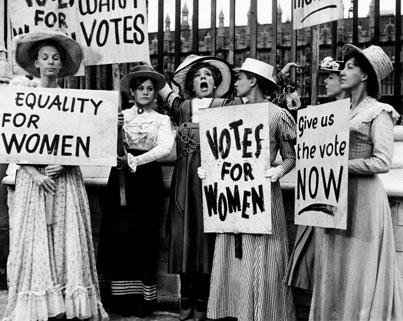
Women's suffrage activists holding signs about voting rights for women

Some of the most famous women associated with the Women's Suffrage movements are Susan B. Anthony, Alice Paul, Elizabeth Cady Stanton, Lucy Stone, and Ida B. Wells. Susan B. Anthony was born to a Quaker family and became a teacher before becoming a famous activist and leader of the NAWSA. In the 1850's, Anthony started campaigning for women's rights and against slavery. She was a firm believer that no right should granted unless it is granted to both men and women. Susan B. Anthony actually worked with Elizabeth Stanton and established the Women's New York State Temperance Society, the New York State Women's Rights Committee, and the American Equal Rights Association in 1866. Susan B. Anthony passed away before she was able to legally vote but is remembered as one the most famous women's suffrage activists. 

Image result for women's suffrage

Elizabeth Cady Stanton was a famous activist who worked with Anthony. She was born in New York in the early 1800's. She was exposed to the inequality between men and women when she was turned away from an abolitionist convention for being female. Stanton then joined the suffrage movement and worked with other activists and helped organize the Seneca Falls Convention in New York. Stanton voiced her opinion that laws for marriage and divorce should be reformed, women should have more access to education, and there should be less restrictions on clothing. Elizabeth Cady Stanton also passed away before the ratification of the 19th Amendment but is a famous women's suffrage figure in history. 

Alice Paul is another important figure and is known for leading the "militant wing" of the suffrage movement. Paul was born to a Quaker family in New Jersey and got her feet into the movement quickly. After 2 years with the NAWSA, she helped co-found the Congressional Union and eventually founded the National Women's Party. Paul endured the pain of imprisonment, hunger strikes, and force feedings to gain publicity for the movement. Alice Paul was a huge driving force in ratifying the 19th Amendment.

Image result for women's suffrage

Lucy Stone is another famous women's suffrage activist and abolitionist. She was a rebel at an early age by going to college against her parents' wishes. In 1847 she actually became the first woman from Massachusetts to earn a Bachelor's degree. Stone started working with the American Anti-Slavery Society which led her to her passion for public speaking. Later in 1868 she cofounded the State Women's Suffrage Association of New Jersey and eventually became the president of the organization. One thing Stone is famous for is refusing to take her husband's last name after getting married. Lucy Stone was an incredible activist who portrayed equal rights in her own life as well as her work.

Lastly, Ida B. Wells was a woman born into slavery but freed by the Emancipation Proclamation. Wells and her family faced lots of discrimination and prejudice in their lives but they rose above it. Wells' father was on the board of trustees at a university and this is where she received early schooling. She soon began writing for news paper about race issues and politics in the South. Ida Wells launched a crusade for anti-lynching laws and worked to expose the harsh life as an African American in the South. She fought hard for her cause until she died in 1931. These 5 brave and courageous women helped America get to where we are today. Although we still have a lot more to do, we must remember the women who started this cause.

Image result for Woman Suffrage


Sources:

Tuesday, February 4, 2020


Who Rules the Court?

In 1789, the Supreme Court was established and the court system of America was changed forever. The Supreme Court is known as the most powerful judicial body on planet Earth. Nine justices make up the Supreme Court and to get here you must be appointed by the President and confirmed by the Senate. An average term for a justice is 16 years but typically lasts longer. Since the establishment of the Supreme Court, there have been over 100 justices. 

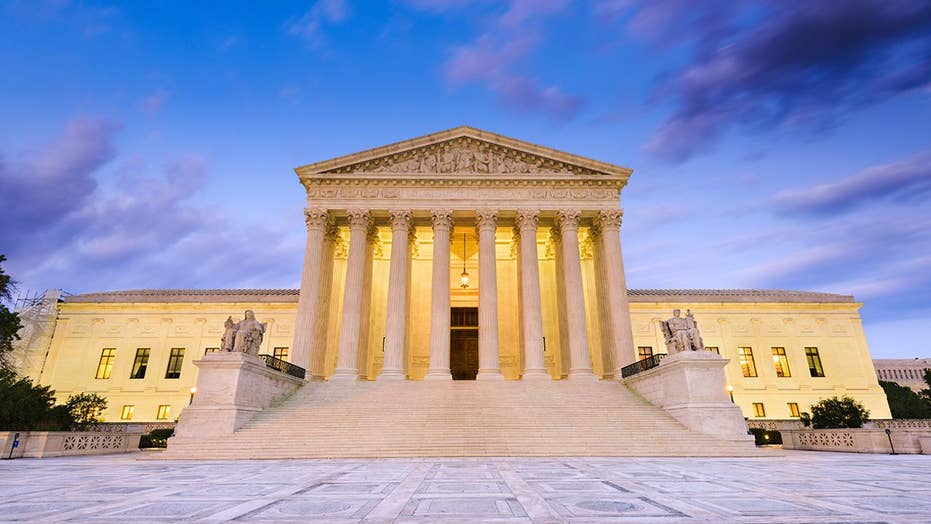
Image result for supreme court"

What makes this court so powerful is that they have the ability to the tell the President, Congress, and the States what they can and cannot do. The Supreme Court also has what is called original jurisdiction and appellate jurisdiction. Original jurisdiction states that the Supreme Court is the first and only court to hear cases. However, the Constitution limits this jurisdiction to matters between states, or regarding ambassadors/high-ranking ministers. Appellate jurisdiction is the authority the Supreme Court is granted to review the decisions of lower courts.

Image result for founding fathers"

Around 7,000 cases arrive at the Supreme Court each year and only about 100-150 cases are accepted. Most of these cases arrive as petitions for "certiorari" meaning written arguments to persuade the Supreme Court that a ruling in a lower court was incorrect. Justices and their law clerks will sit down and review cases then decide which ones to accept. The case then has to be voted on by all 9 justices. Four out of nine votes are needed to accept a case, and five out of nine votes are needed to grant a stay. The inner workings of the Supreme Court have been built over the last 200 years. This court protects citizens against federal and state power and will continue to do so. 


Sources:

The World We Live In I bet if you ask your parents, "Did you think we would have all this technology when you were younger?...